We spent the last issue talking about what happens when founders build on infrastructure they do not own. The pattern goes deeper than any single tool category. This issue is about where it leads next
The conversation has shifted. A year ago, the question companies were asking was: should we use AI? That question is closed. The answer is yes, and the companies that are still debating it have already fallen behind.
The question now is sharper and harder: how do you build AI into your operations so it compounds over time rather than sitting beside your workflows as a productivity toy?
That question does not have a simple answer. But it has a clear frame. And most companies are missing it.

Most companies have added AI to their stack. Almost none have redesigned their operations around it. That is the gap.
01 - What Agentic AI Actually Means
There is a word getting used everywhere right now: agentic. Agentic AI. Agentic workflows. AI agents. If you work in tech, you have seen it in every investor memo, product announcement, and LinkedIn post for the last eight months.
Here is what it actually means, stripped of the hype.
Traditional AI tools respond. You ask a question, you get an answer. You type a prompt, you get output. The interaction is one-shot. The AI is a tool you operate.
Agentic AI acts. It receives a goal, breaks it into steps, executes those steps autonomously, monitors the results, and adjusts. It is not waiting for your next prompt. It is working through a process.
The practical version of this is already deployed at serious companies. An agentic system that monitors your support queue, classifies incoming tickets, resolves the ones it can, escalates the ones it cannot, and reports on patterns - without a human touching the workflow at any stage. An agentic sales assistant that enriches your CRM, identifies which deals are going cold, and drafts the follow-up without being asked. An agentic reporting system that pulls data from six sources, reconciles figures, generates a formatted board report, and flags anomalies for human review.
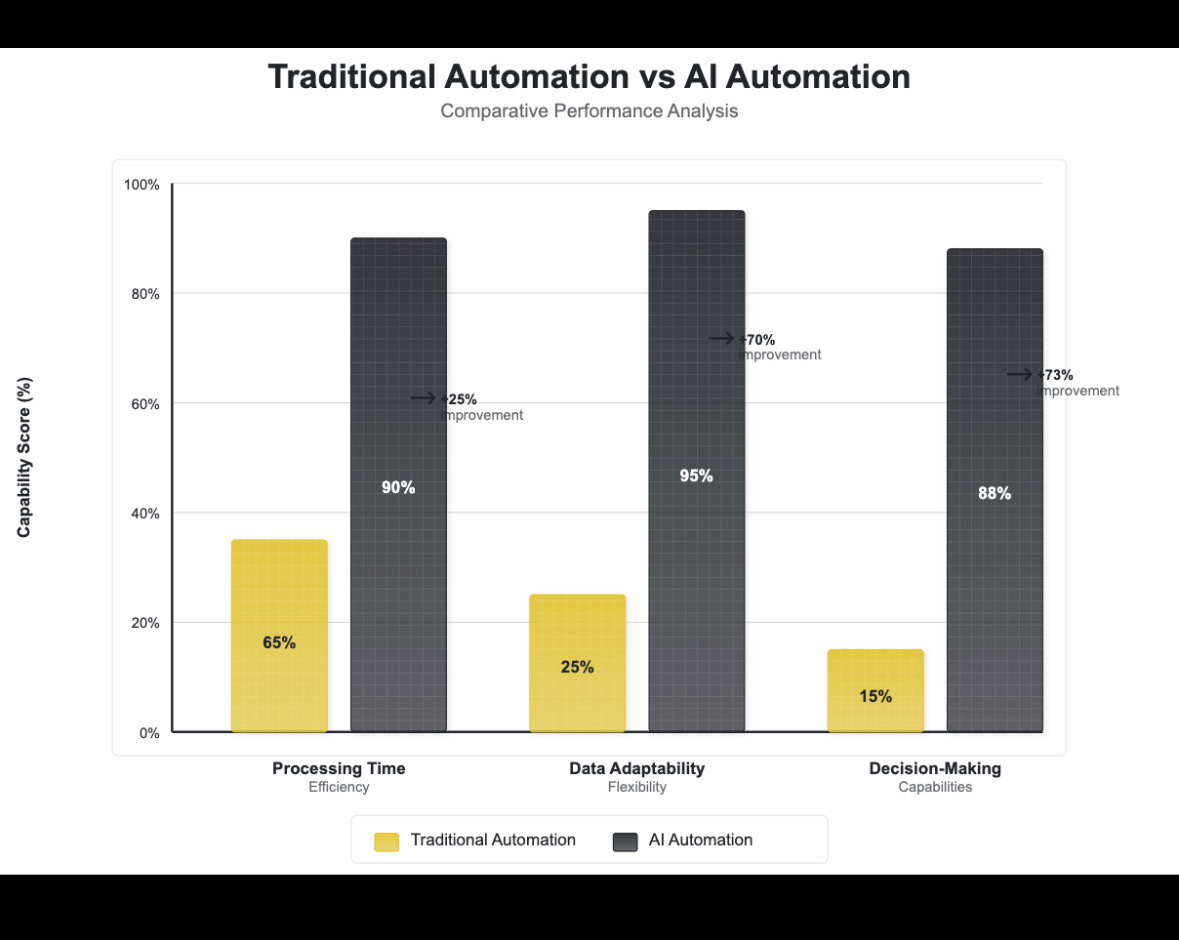
This is not science fiction. The infrastructure to build these systems is accessible today, and the gap between companies that have built them and companies that have not is already showing up in operational efficiency, headcount decisions, and deal velocity.
What most companies are doing instead is using ChatGPT to draft emails and calling it an AI strategy.
02 - The Vibe Coding Problem
Something else is happening in parallel that is worth talking about honestly.
Vibe coding - the practice of building software by prompting AI tools rather than writing code directly - is real, it is accelerating, and it is creating a new class of technical debt that has not fully shown up yet.
The pitch is compelling: a non-technical founder can describe what they want, and an AI tool assembles the code. In hours, not months. At a fraction of the cost. For a certain class of prototype or internal tool, this is genuinely useful.
Speed without architecture is not progress. It is deferred cost.
Here is what is not being talked about loudly enough.
Code produced by AI tools without architectural oversight tends to have no coherent data model, no documented logic, no test coverage, and no clear migration path. It works until it does not. And when it stops working - at the moment the company needs to scale, onboard a new developer, or go through due diligence - the rebuild cost is significant.
We have seen this pattern twice in the last six months. Both companies built quickly using AI-generated code, both shipped products, both found growth. And both came to us at the point where the codebase had become impossible to extend without rewriting large portions of it.
The companies that will win are not the ones building fastest. They are the ones building with enough structure that what they build today still works when it matters.
03 - Where This Leaves Founders Right Now
If you are a founder, operator, or organizational lead reading this, here is the practical frame.
You are probably in one of three positions.
The first: you have not made serious AI investments yet. You are watching the market, waiting to see what solidifies. This is a reasonable posture, but the window for it is closing. The companies that treat the next 18 months as the period to build AI into their core operations are going to have compounding advantages that are difficult to match in 2027.
The second: you have added AI tools to your stack. Your team uses them. You have saved time. But your operations are fundamentally the same shape they were two years ago, and the AI sits beside your workflows rather than inside them. This is the most common position. It is not a competitive advantage. It is productivity.
The third: you are redesigning your operations around AI capabilities. Not adding tools. Asking which decisions, communications, reports, and processes should be owned by AI systems rather than human labor. Building those systems with real data architecture underneath them. This is the position that compounds.

The question is not what AI tools your team uses. It is what AI systems your business runs on.
Most organizations need to move from position two to position three. The gap between those positions is not about technology access. It is about the clarity of the question you are asking and the discipline of the design process you apply to answer it.
04 - What We Are Building at Kivara
In the next quarter, we are publishing a case study on an agentic reporting system we built for a portfolio management client - a system that runs a complete reporting cycle across 20 data sources, produces formatted outputs for different stakeholder audiences, and flags exceptions for human review. End to end, without a staff member touching it. We will publish the architecture and the decisions behind it.
We are also close to announcing our first dedicated product under AfroInnovate, our Africa-focused practice. It addresses a specific operational problem in the solar and energy sector on the continent, where portfolio monitoring is largely manual and board reporting takes days per cycle. More on that very soon.
If any of what we covered today describes where your company is - whether on the AI implementation side or the infrastructure side - the best next step is a direct conversation. No pitch. No deck. A conversation about what your operations actually look like and where the leverage is.